

Release and Implementation It was jointly issued by the National Health Commission and the State Administration for Market Regulation on September 25, 2025 (Announcement No. 6 of 2025), and officially implemented on September 2, 2026. It is one of the four food contact material standards among the 32 newly released national food safety standards and the two standard amendments.

Scope of application and definition It is applicable to silicone rubber materials and products for food contact (referring to materials and products mainly made of organosilicon elastomers formed by cross-linking and curing of polysiloxane polymers and hydrophobic silica, etc., which may come into contact with food/food additives or whose components may transfer to food during expected use) It will replace the relevant requirements regarding silicone rubber in GB 4806.11-2016.
The core revision contents: Compared with the original standard, 10 key aspects have been adjusted, including the scope of modification, terms and definitions, raw material requirements, sensory requirements, physical and chemical indicators (with the addition of volatile substances), migration test requirements, label marking requirements, and Appendix A. At the same time, other technical requirements and Appendix B (determination of volatile substances) have been newly added.
Regarding general physical and chemical indicators: To better manage the safety risks derived from silicone rubber, taking into account the material properties of silicone rubber, the results of market sampling tests, and the principle of standard coordination, this revision uniformly adjusts the test conditions for potassium permanganate consumption and the migration of heavy metals (calculated as Pb) to 60℃ for 2 hours. At the same time, for volatile substances such as cyclosiloxane oligomers, a new item of "Volatile Substances" and its supporting detection method, "Appendix B Determination of Volatile Substances", has been added.
Regarding migration tests: Based on the research on the migration test rules of silicone rubber materials and products, this revision has removed the special regulation that "for oily foods, 50% ethanol solution (volume fraction) should be selected as the food mimicant." The selection of food simulants for migration tests of silicone rubber materials and products shall be uniformly carried out in accordance with the provisions of the "National Food Safety Standard - General Rules for Migration Tests of Food Contact Materials and Articles" (GB 31604.1-2023).
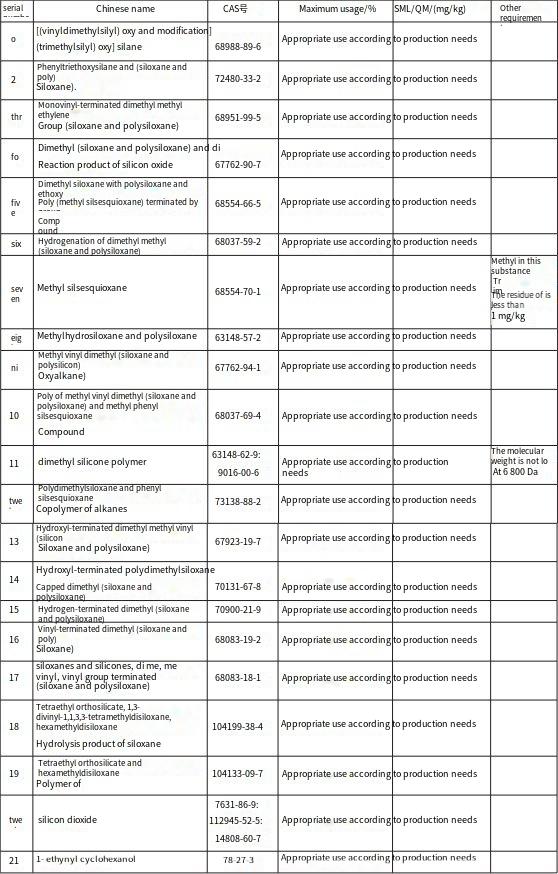
Appendix A:
The basic raw materials permitted for use in silicone rubber materials and products for food contact and their application requirements:
Appendix B
Determination of volatile substances
B.1 Range
This standard specifies the determination methods for volatile substances in silicone rubber materials and products for food contact.
This standard is applicable to the determination of volatile substances in silicone rubber materials and products for food contact.
B.2 Principle
After pretreatment of the samples of silicone rubber materials and products for food contact, the liquid loss of the samples under normal pressure and after being heated and baked for a certain temperature and time was measured to obtain the amount of volatile substances of the silicone rubber materials and products for food contact under the corresponding conditions.
B.3 Reagents and materials
B.3.1 Reagents
Water: Grade III water in compliance with GB/T 6682.
B.3.2 Materials
B.3.2.1 Containers: Surface dishes, evaporating dishes, weighing dishes, crucibles, etc.
B.3.2.2 Weighing dish: Aluminum, flat.
B.3.2.3 Dryer: Equipped with desiccant.
B.4 Instruments and Equipment
B.4.1 Electronic balance: Sensitivity is 0.1 mg.
B.4.2 Electric Heating Blower Drying Oven: Temperature control accuracy (100±2)℃, temperature control accuracy (200±3)℃.
B.5 Analysis Steps
B.5.1 Sample Pretreatment
Soak the pacifier samples in slightly boiling water for 10 minutes, stirring them from time to time during the soaking process to ensure that the samples do not touch the container walls. After soaking, take out the sample, shake off the water. If the next step of the test cannot be carried out immediately, place the sample in a desiccator for storage. Other samples do not require pretreatment.
B.5.2 Sample Preparation
Cut the sample into fragments with a length, width and thickness not exceeding 2cm each, and place them in an appropriate container, ensuring that the sample fragments do not overlap with each other. Place the container containing the sample fragments in an electric hot air drying oven at (100 ± 2)℃, dry for (60±5) minutes, then take it out and cool it in a desiccator for (60±5) minutes for determination.
B.5.3 Determination
Place the weighing dish in an electric hot air drying oven at (200±3)℃ to dry for at least 60 minutes. After taking it out, place it in a desiccator to cool for at least 60 minutes, and then weigh the mass of the empty dish (accurate to 0.1 mg). Repeat the above drying steps until the difference in the mass of the empty dishes from the previous and subsequent weighs does not exceed 2.0 mg, and record the mass of the empty dishes in m. Take approximately 10g of the sample fragments to be tested from B.5.2 and place them in a constant-weight weighing dish. Ensure that the sample fragments do not overlap with each other. Weigh the total mass m of the sample fragments and the weighing dish (accurate to 0.1mg). Place the weighing dish containing the sample fragments in an electric heating effect air drying oven at (200±3)℃, dry for (240±5) minutes, then take it out and cool it in a desiccator for (120±5) minutes. After that, weigh the total mass m(accurate to 0.1mg) of the sample fragments and the weighing dish.
B.6 Presentation of the Analysis Results
The mass of volatile substances in the sample is calculated according to formula (B.1) :
In the formula:X=(M1-M2)/(M1-M0)*100%
X - The amount of volatile substances in the sample, measured in grams per 100 grams (g/100 g);
M1 - The total mass of the sample and weighing dish before drying, in grams (g);
M2 - The total mass of the sample and weighing dish after drying, with the unit of grams (g);
M0 - The mass of the empty weighing dish, with the unit of grams (g).
The results are expressed as the arithmetic mean of two independent determination results obtained under repeatability conditions, rounded to two decimal places.
B.7 Precision
When the amount of volatile substances in the sample is ≤0.2g/100g, the difference between two independent determination results obtained under repeatability conditions shall not exceed 30% of their arithmetic mean. When the amount of volatile substances in the sample is less than 0.5g /100g, the difference between two independent determination results obtained under repeatability conditions shall not exceed 20% of their arithmetic mean; when the amount of volatile substances in the sample is greater than 0.5 At g/100g, the difference between two independent determination results obtained under repeatability conditions shall not exceed 15% of their arithmetic mean.
DOIT Rubber is a high-tech enterprise specializing in precision rubber sealing components for global healthcare, automotive, electronics, and industrial sectors.
Backed by ISO 13485 certification and 20+ core patents, we excel in manufacturing Medical Grade Silicone Seals, IVD Seals and Diagnostic Device Gaskets, matching the strict requirements of In Vitro Diagnostic (IVD) Equipment Accessories. Our portfolio also covers custom seals for automotive electronics, pumps, valves and industrial machinery, delivering superior biocompatibility, corrosion resistance and stability.We offer OEM/ODM services with global supply capacity, serving customers across Asia, Europe and the Americas.
Contact: jack_pan@doitrubber.com; Whatsapp: +86 15976889589